
Memories of Kumiben Lakhia – Harbinger of change
– A Tribute by Uttara Asha Coorlawala
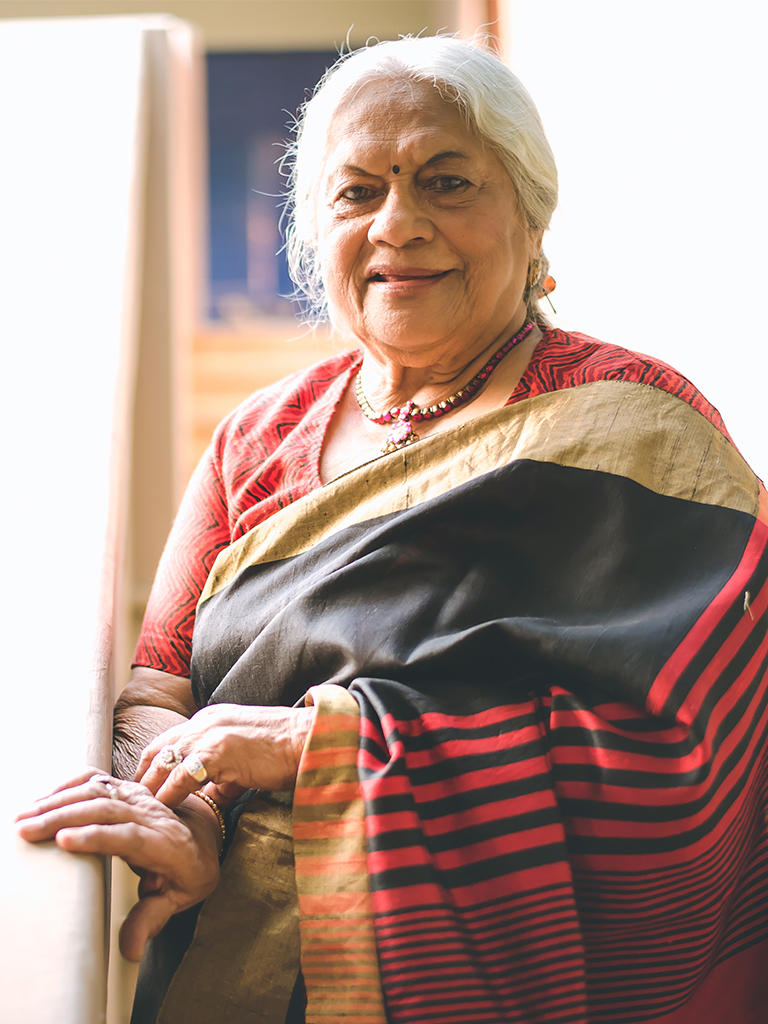
In 1984, in Bombay at the East-West Dance Encounter, was when I first saw some kathak that had an exciting contemporary flair, simpler yet figure flattering costumes, dancers flowing in and out of spatial group patterns (as opposed to solos) and flashing through rhythmic designs. I was floored. Until then Kathak had always seemed like a heritage dance form, old precious, subtle complex. And the choreographer of this iconic dynamic new kathak was none other than Kumudini Lakhia from Ahmedabad. Her methods were quickly appropriated by so many kathak dancers that what once was perceived as daring and avante garde soon became mainstream!
The next day at the seminar following the performance described above, Kumudiniben spoke to the small tightly curated gathering of dancer-choreographers. Referring to the content of most kathak abhinaya of her time, that consisted of dances of the gopis pining for or playing with Krishna, – Kummudiniben said simply and with conviction – “I want a divorce from Krishna” A dead silence followed her announcement. Then all participants stood up and cheered. At last the subject of dance could be normal middleclass women with their realistic concerns!
In the years that followed that pivotal moment, I had many opportunities to be swept away by her choreographic brilliance, her ready witty, cheeky but observant responses and her compassionate relationship with younger dancers. She graciously agreed to appear on our Erasing Borders on the September 22nd, 2021 virtual Dance Festival. Accolades and memorial recollections have been pouring in, an icon for so many. Dearest Kummiben, you worked hard and gave generously to generations following you. RIP
—
Uttara Asha Coorlawala
Senior Curator,
IAAC Erasing Borders Dance Festival

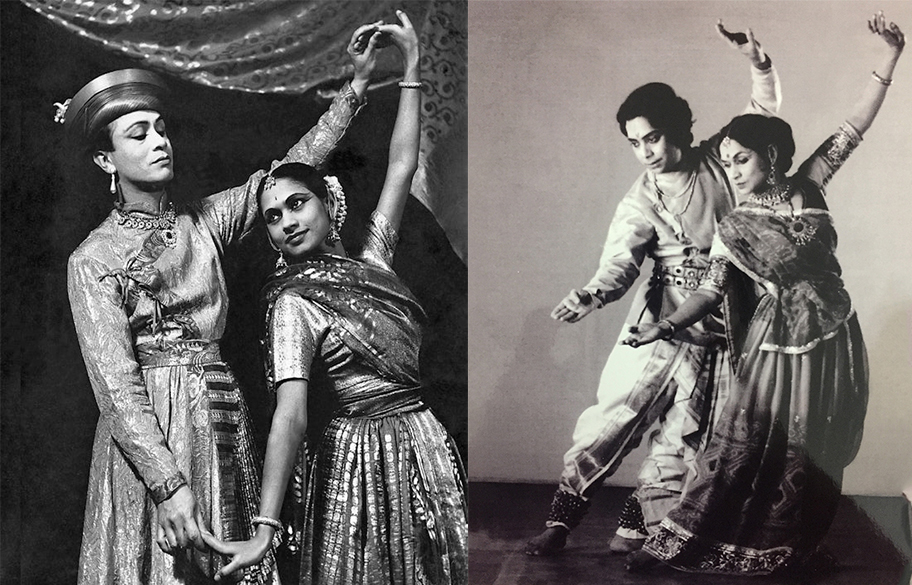
Left Ram Gopal and Kumiben Lakhia, Right Birju Maharaj ji and Kumiben Lakhia
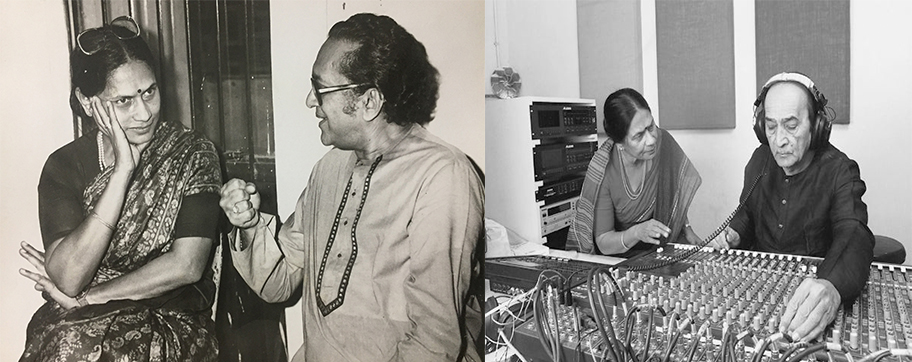
Left Ravi Shankar and Kumiben Lakhia Right Atul Desai and Kumiben Lakhia
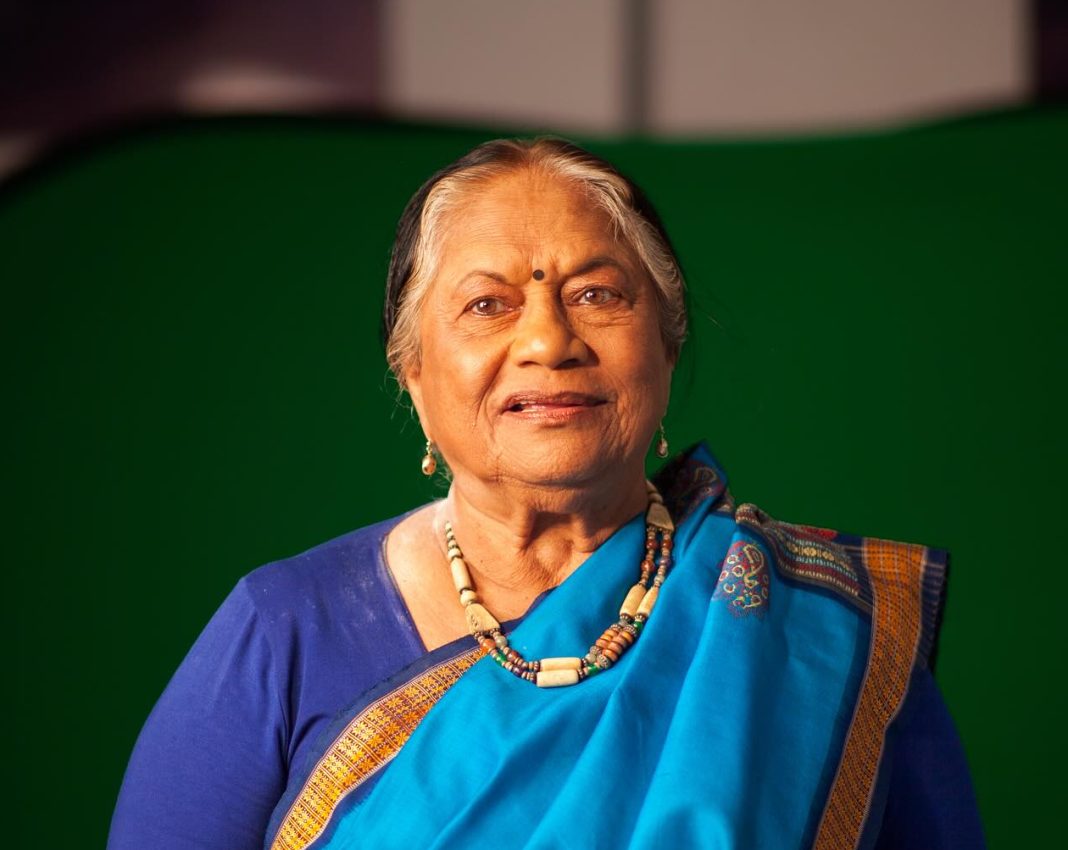
Kumudini Lakhia
By Uttara Asha Coorlawala (as published in the Routledge Encyclopedia of Modernism, 2016)
Kumudini Lakhia’s career over more than sixty years as dancer, choreographer, and teacher, have ushered kathak into modernism. Kathak is considered a traditional art dance indigenous to north India and modernism is often conflated with the dominance of Euro-American cultural aesthetics in the twentieth century. This opposition has been as generative for Kumudini Lakhia’s creativity, as it has inhibited the acceptance of her work in India.
Kumudini Lakhia has been awarded the civilian honour of the Padma Shri in 1987, the Padma Bhushan in 2010, the Sangeet Natak Akademi Award, India’s highest award for performers, in 1982, and Kalidas Samman for the year 2002-03. Her company performed in major festivals from Toronto CA and Mexico, to the Kremlin and of course in India. Her services as Guest-speaker, master-teacher, choreographer are very much in demand as she continues to travel world wide from her home in Ahmedabad and the dance school Kadamb.
Lakhia’s early training was with Jaipur gharana exponent, Radhelal Misra, and later from the renowned Shambhu Maharaj of the Lucknow gharana. In between she had danced bharatanatyam, Kathak and other Indian forms with Ram Gopal in his tours to the UK and the USA. Here, critics noticed the clarity of her lines, her strong presence, virtuosic spins, and subtle expressiveness. This experience of adapting to styles and stages on the European theater circuit, would feed into her later work as a choreographer.
When Lakhia initially presented her own choreography, it often caused sensational backlash from conservative critics in Delhi. In time, and especially after Birju Maharaj publicly endorsed her creative contributions to his own choreographies, her innovations have been appropriated into the general kathak repertory! Yet her choreography remains distinctive and her students have gone on to excel in their own explorations of new directions in dance.
Kathak had for years evolved as solo tradition, meant to be interactively performed in intimate spaces for elite dance lovers who knew the poetic and visual images being evoked. Kumudini built on her ability to analyze Kathak rules and figure out how to extend the same rules for multiple dancers without indulging in ‘multiplication’ for mindless spectacle. She taught her dancers to draw attention to spaces between and around themselves, using spirals, asymmetry and levels to increase a sense of depth and sculptural elegance.
Discarding Krishna themes and coy ploys, she used structural devices within kathak to set up dialogues between characters, and varied the dynamics of rhythms to express emotional changes rather than literal mime. She chose her texts carefully so that her dances would enrich meanings rather than lose the layers so typical of abhinaya.
By focusing on the materials of the traditional form, but utilizing them in new and startling ways, by transferring narrative focus from religion and mythology to the concerns of every day middle class women and by her use of costumes carefully designed to move fluidly with the dancers, – Kumudini Lakhia modernized kathak translating its parameters into accessible but nuanced contemporaneity.
LIST OF WORKS:
2009 two dances for Akram Khan Co. UK for the Svpanagatha festival at Sadler’s Wells, UK
2009 ‘Punarnava’ for Kathak Kendra Repertory , New Delhi
2007 ‘ Arpan‘performed by Kadamb at KIOI Hall in Japan
2006 Co choreographer ‘Rasa’ for Natya Dance Theatre, Chicago
2006 ‘Hagoromo’ – Feathered cloth for Yuko Inoue, from Japan.
2006 ‘Anuma‘ (to collect) for Kalpana Festival in Kolkatta
2005 ‘Mushti’ choreographed for Nirupama and Rajendra, Bangalore
2005 Chakravuha, the story of Abhimanyu’ for Akram Khan & Co. U.K.
2004 Ruins’ for Anurekha Dance Co. U.K. , Funded by the Midland Arts Council , UK
2003 Samanvay
2002 Sambhawami
2002 Radha –Raman
2001 Kathak Through Ages
1999 Fulwari (children’s production )
1999 Panchtatva (children’s production )
1999 Bhav Krida
1999 Chaturang
1998 Drums of Freedom (To commemorate 50 years of India’s Independence- Gujarat State)
1998 Suvarna (For Fifty years of India’s Independence – Brazil)
1997 Nav Rasa
1996 Pratibimb
1995 Udhav Shatak
1995 Venu Geet
1993 Sam Samvedan
1993 Gat Gati
1993 Adhar Madhur
1993 Golden Chains (for Neena Gupta , London , U.K .)
1993 Indra Dhanu (for Nilmani Dance Centre , Leicester , U.K.)
1993 Hun – Nari
1992 Shravan
1992 Kamayani (Bharatiya Kala Kendra – New Delhi )
1991 Agni (For Padatik , Calcutta )
1991 Time Cycle (For Nahid Siddiqi , Birmingham , U.K. )
1991 Ritu Samhar (International Dance Festival in New Delhi )
1991 Chayan (Festival of India in Germany )
1990 Okha Haran (based on Maan Bhatt tradition of Gujarat)
1989 Bharati
1987 Setu
1986 Kathak and The Child
1986 Hastak
1986 Haveli Sangeet
1986 Jantar Mantar(Apana Utsav Festival in New Delhi )
1985 Tarana
1985 Bhajan
1985 Rachyo Raas
1985 The Peg
1984 Chharika
1983 Kaleidoscope (Children’s production )
1982 Kathak Kahe So
1981 Atah Kim (restaged in 2007in Singapore, Indonesia , New Delhi)
1979 Govind Vande Ahmedabad and Gandhinagar
1979 Dashavatar (Children’s production )
1978 Chaturang
1978 Yugal
1977 Aaradhana
1976 Prarambh (For Ahmedabad Doordarshan )
1975 Ek Thaa Gaon (Children’s production )
1975 Alak Malak (for Ahmedabad Doordarshan )
1975 Stuti
1975 Vriksha (Children’s production )
1974 Drashtikon
1974 Chhaya Nat
1974 Baadashah Salamat
1973 Shakti
1973 Dhabkar
1972 Prem Chakshu (Children’s production )
1971 Sargam (Children production )
1971 Panch Paaras
1971 Kolaahal
1971 Duvidha
1970 Venu Nad
1970 Hori
1969 Variation In Thumri
Further Reading
Chakravorty, Pallabi, Bells of Change pp.152-160 (Some of Lakhia’s innovative works are described within a book on contemporary kathak and women practitioners. In Kolkatta)
Kothari, Sunil Kathak. Indian Classical Dance Art. New Delhi: Abhinav Publications 1989.(With beautiful illustrations of kathak sequences, by prominent performers, and descriptions of the form. This book also includes a history of kathak as a dance genre and of its proponents.
Kothari, Sunil, “kathak Kim? Asks Kumudini Lakhia” in attendance, 2001 Uday shankar and Choreography Special Ed. Ashish Khokar, New Delhi: Ekah Printways 2001 pp 84-87 (An interview by Sunil Kothari)
Lakhia, Kumudini, “Innovations in Kathak” Kothari, Sunil, Ed. New Directions in Indian Dance Bombay: Marg Publications/National Centre for Performing Arts 2003 60-69 (Lakhia describes her choreographic intentions and motives. Illustrated with photographs)
Shah, Reena, Movement in Stills: The Dance and Life of Kumudini Lakhia Ahmedabad: MapinLit 2005 (This biography of the dancer and her dances is fluid reading and includes descriptions of her works.)